[ad_1]

Author: Shincy George | Nursing Manthra
Canada is one of the most popular destinations for internationally educated nurses seeking better career opportunities, professional growth, and quality of life. One province actively welcoming internationally educated nurses is New Brunswick.

In this article, we will explain the complete step-by-step process to apply for Registered Nurse (RN) licensure through the College of Nursing of New Brunswick (CNNB) for nurses who completed their education outside Canada.
Quick Answer

Internationally educated nurses who want to work as Registered Nurses in New Brunswick must apply through the College of Nursing of New Brunswick (CNNB). The process includes registering with the IEN Navigation Service, completing credential verification through NNAS, submitting required documents, meeting language requirements, and completing mandatory courses before receiving RN registration.
This guide will cover:
- Province overview
- Eligibility requirements
- Step-by-step RN licensing process
- Required documents
- Application fees
- Important tips for internationally educated nurses
New Brunswick is one of Canada’s Atlantic provinces known for its high demand for healthcare professionals, especially nurses. The province offers strong support systems for Internationally Educated Nurses (IENs) including financial support, immigration assistance, and employment opportunities.
To support foreign nurses, the government introduced the IEN Navigation Service, which helps nurses complete the licensing process smoothly.
Major benefits for nurses in New Brunswick include:
- Government support programs for IENs
- High demand for Registered Nurses
- Assistance with immigration pathways
- Opportunities in hospitals, long-term care facilities, and community health
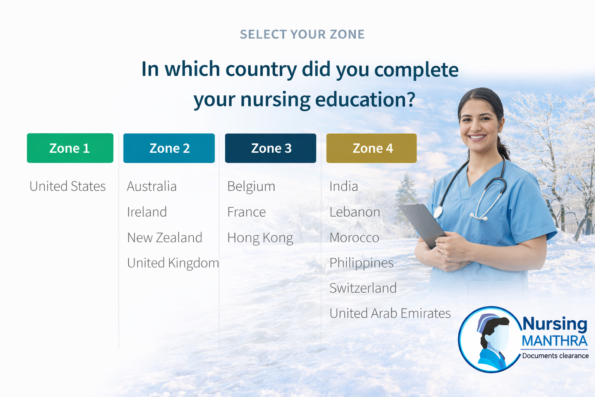
Other countries comes under Zone 5.
Step 1: Register with the IEN Navigation Service:
Before applying to the College of Nursing of New Brunswick, all internationally educated nurses must first register with the Province of New Brunswick IEN Navigation Service.
To start the process, send an email to: [email protected]
This step is very important because many applicants can receive funding support for the licensing process.
Step 2: Apply to NNAS (National Nursing Assessment Service):
The next step is to apply through NNAS, which evaluates your nursing education and credentials.
NNAS will collect verification from:
- Nursing school transcripts
- Nursing council registration
- Employment verification
After submission, NNAS prepares an Advisory Report, which will be sent to the College of Nursing of New Brunswick (CNNB).
Step 3: Apply to the College of Nursing of New Brunswick (CNNB):
Once the NNAS advisory report is completed, applicants must apply to CNNB for registration.
During the application process you must indicate whether you registered with the IEN Navigation Service for funding.
If funding is approved, the province may cover certain costs.
The main fees for internationally educated nurses include:
RN Application Processing Fee—-$460 CAD
Temporary Registration Permit (TRP)—-$57.50 CAD
Note:
- Fees are non-refundable
- Applicants should only apply if they intend to work in New Brunswick.
The application fee will be invoiced after submitting your application.
However: If you selected YES to the question:
“Have you registered with the Province of New Brunswick IEN Navigation Service for funding?”
Your application will be held until CNNB receives confirmation of funding from the IEN Navigation Service.
This means you may not need to pay immediately if funding is approved.
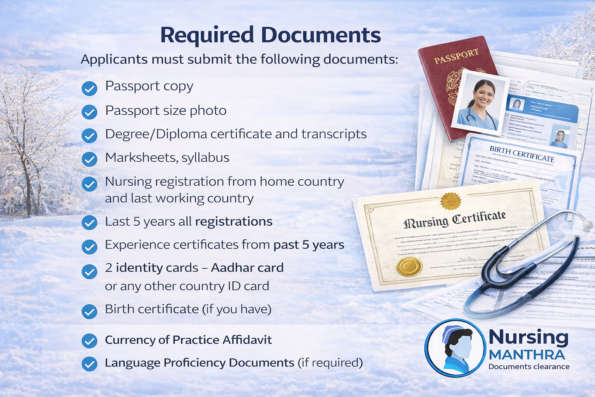
Applicants must submit the following documents:
CNNB Application Form
Currency of Practice Affidavit
Declaration Questions
Language Proficiency Documents (if required)
Criminal Record Check
Criminal Record Checks are valid for 6 months only.
Applicants must provide a CRC from every country where they lived or worked in the past 5 years.
CRC can be submitted through: CSI Screening
Website: www.csiscreening.com
Applicants must indicate CNNB as the organization and the report must be sent directly to CNNB.
Important:
CNNB will not accept CRC documents sent directly by the applicant
These must be sent directly by the issuing organization.
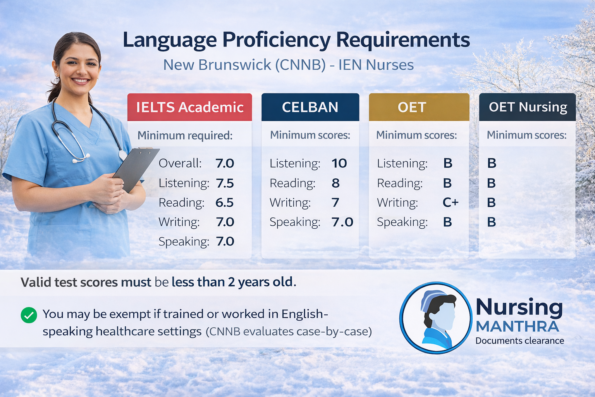
What CNNB accepts as Language Proficiency evidence
CNNB says you can meet language proficiency by one of these routes:
- Approved language test scores (benchmarked scores)
- Current registration in another Canadian jurisdiction
- Nursing program completed in English or French
- Other evidence submitted for review (case-by-case)
To qualify for RN registration in New Brunswick, applicants must demonstrate recent nursing practice experience.
Requirement:-1,125 hours of nursing practice within the last 5 years
If applicants do not meet this requirement, they may be required to complete:
- Inspair Global Competency Assessment
- IEN Bridging Program
After reviewing the application, CNNB may require completion of several mandatory courses, including:
- Professional Nursing in Canada
- Professional Communication
- Medication Administration
- Health Assessment
These courses are usually offered through:
- New Brunswick Community College (NBCC)
- Collège Communautaire du Nouveau-Brunswick (CCNB)
Applicants will be referred to these institutions if required.
After completing mandatory courses, eligible applicants may receive a:
Temporary Registration Permit (TRP)
Key details:
- Usually issued for 6 months
- Allows nurses to start working under conditions
- Must complete the Adaptation Plus Program
After receiving the TRP, nurses can begin the Adaptation Plus Program with their employer.
Important points:
- Program must be completed within 1 year
- Includes competency assessment
- Supervised clinical practice
After completing all requirements, applicants must pass the Entry-to-Practice Exam to become a fully licensed Registered Nurse in New Brunswick.
- Application fees are non-refundable
- Criminal record checks are valid for 6 months
- Experience requirement: 1,125 hours in the last 5 years
- Many applicants may receive financial support from the province
1. Who can apply for Registered Nurse (RN) registration in New Brunswick as an internationally educated nurse?
Internationally educated nurses who completed their nursing education outside Canada and are not currently registered as an RN in another Canadian province or territory can apply through the College of Nursing of New Brunswick (CNNB). Applicants must complete the required credential evaluation, submit documents, and meet the practice and competency requirements.
2. What is the first step for internationally educated nurses applying to CNNB?
The first step is to register with the New Brunswick IEN Navigation Service before applying to CNNB.
Applicants must send an email to: [email protected]
Subject line: IEN Support Program
This service provides guidance for the licensing process and may offer financial support, immigration assistance, and employment guidance.
3. Do internationally educated nurses need to apply to NNAS before CNNB?
Yes. Most internationally educated nurses must first apply to the National Nursing Assessment Service (NNAS).
NNAS evaluates your:
- Nursing education
- Professional registration
- Work experience
After the evaluation, NNAS sends an Advisory Report directly to the College of Nursing of New Brunswick.
4. How much is the application fee for RN registration in New Brunswick?
For internationally educated nurses, the RN application processing fee is approximately $460 CAD.
Additional fees may include:
- Temporary Registration Permit (TRP): $57.50 CAD
Please note that all CNNB fees are non-refundable.
5. Do I need recent nursing experience to apply for CNNB registration?
Yes. To meet the Currency of Practice requirement, nurses must have completed:
1,125 hours of nursing practice within the last 5 years.
If applicants do not meet this requirement, they may be asked to complete:
- Competency assessment through Inspair Global Assessment
- IEN Bridging Program
6. What documents are required for the CNNB RN application?
Applicants must submit several documents, including:
- CNNB Application Form
- Currency of Practice Affidavit
- Declaration Questions
- Language proficiency documents (if required)
- Criminal Record Check
- NNAS advisory report
Some documents such as transcripts and NNAS reports must be sent directly from the issuing institutions.
7. How do I complete the Criminal Record Check (CRC)?
Applicants must provide a Criminal Record Check for any country where they lived or worked in the last five years.
The CRC can be completed through CSI Screening:
Website: www.csiscreening.com
The report must be sent directly to CNNB and cannot be submitted by the applicant.
8. What happens after my CNNB application is reviewed?
After reviewing your application, CNNB may require you to complete mandatory nursing courses, such as:
- Professional Nursing in Canada
- Professional Communication
- Medication Administration
- Health Assessment
These courses are usually offered through:
- New Brunswick Community College (NBCC)
- Collège Communautaire du Nouveau-Brunswick (CCNB)
9. What is the Temporary Registration Permit (TRP)?
A Temporary Registration Permit (TRP) allows internationally educated nurses to begin working under certain conditions while completing the remaining licensing requirements.
Important points:
- Usually issued for 6 months at a time
- Nurses must complete the Adaptation Plus Program
- The program must typically be completed within one year
After completing all requirements, nurses can proceed to the Entry-to-Practice examination and full RN registration.
10. If I already passed the NCLEX-RN, can I register as an RN right away?
Not immediately. Even if you have successfully cleared the NCLEX-RN, if you have never been registered as an RN in any Canadian province or territory, you must still complete the NNAS verification and assessment process.
NNAS is required to confirm your education, registration history, and credentials through official sources before CNNB can finalize your registration pathway.
11. I was told to complete mandatory courses. Are they still required after passing NCLEX-RN?
Yes. Passing NCLEX does not automatically remove mandatory course requirements.
These learning modules and courses are designed to support IENs in adjusting to:
- The RN scope of practice in New Brunswick
- Professional responsibilities and accountability standards
- Communication, documentation, and medication safety expectations
- The Canadian healthcare system and workplace culture
CNNB works with NBCC and CCNB to help internationally educated nurses transition safely and confidently into New Brunswick practice settings.
12. How many times can I attempt the NCLEX-RN exam while working as a Graduate Nurse (GN)?
Once you complete all pathway conditions (especially for applicants in Zones 2, 3, 4, and 5), you may be allowed to write the NCLEX-RN as a Graduate Nurse (GN).
Here is how it usually works:
- Under a Temporary Registration Permit (TRP) with conditions, you must complete all required conditions within one year.
- After that, you may become eligible for a TRP without conditions, issued every six months, for a maximum period of two years.
- During this TRP period, you can apply to write the NCLEX-RN.
If you do not pass:
- You can still attempt the NCLEX again, but you may lose the ability to work under TRP, depending on the stage and conditions of your permit.
Also remember:
- Pearson VUE requires a 45-day waiting period between NCLEX attempts.
I was previously told I am eligible to write NCLEX-RN. Has anything changed?
If you received eligibility to write the NCLEX-RN earlier (under the older NANB process), that eligibility generally remains valid. However, there were important timing rules.
In many cases, IEN applicants were given a limited window (commonly six months) to write and pass the NCLEX-RN. If the exam was not written within that period, or if the attempt was not successful, additional steps may be required before continuing.
In that situation, CNNB may direct applicants to complete one of the following before progressing:
- A competency assessment (for example, through an approved assessment provider), or
- A bridging / transition program through NBCC or CCNB
This ensures the applicant meets the current competency and practice readiness requirements before continuing toward full registration.
For other canadian province license process-Please check
- Newfoundland and Labrador—–https://nursingmanthra.com/college-of-licensed-practical-nurses-newfoundland-labrador-canada-license-application-process-for-rn-and-lpn/
- Association of New Brunswick —https://nursingmanthra.com/lpn-licensure-anblpn-new-brunswick-guide/
- Novascotio college of Registered nurse-https://nursingmanthra.com/nova-scotia-college-of-nursing-nscn-canada-licensure-application-process-for-internationally-educated-nurses/
- Ontario-College of Regsitered nurses Ontario-https://nursingmanthra.com/college-of-registered-nurse-in-ontario-canada-cno-licensure-application-process-for-internationally-educated-nursescno-ontario-nursing-registration-2025/
- Saskatchewan college of registered nurses-https://nursingmanthra.com/college-of-registered-nurses-saskatchewancrns-licensure-application-process/
- British Columbia college of nurses and midwifes-https://nursingmanthra.com/bccnm-rn-lpn-registration-guide-ien/
- comprehensive guide to become a nurse in Canada-https://nursingmanthra.com/the-comprehensive-guide-to-registering-as-a-nurse-in-canada/
Conclusion:
New Brunswick offers a structured and supportive pathway for Internationally Educated Nurses to become Registered Nurses in Canada. Through the IEN Navigation Service, many applicants receive assistance with licensing, immigration, and employment.
If you are planning to work in Canada as a nurse, New Brunswick can be an excellent destination due to its strong demand for healthcare professionals and government support programs.
If you are planning to start your New Brunswick (Canada) RN Registration / IEN Application process in 2026, it’s important to follow a clear, step-by-step pathway from the beginning. A well-organized plan will help you avoid delays, document rejection, and unnecessary rework.
Nursing Manthra provides dedicated support for internationally educated nurses applying for Registered Nurse (RN) licensure in New Brunswick, including:
- Eligibility screening and pathway guidance (Zone selection + requirement check)
- IEN Navigation Service registration support (funding guidance)
- NNAS application assistance (documents + source submissions)
- CNNB application support and step-by-step filing guidance
- Document preparation support (forms, affidavits, declarations)
- Criminal Record Check (CRC) guidance (CSI Screening + rules)
- Application monitoring and sequencing support
- Mandatory course / TRP / Adaptation Program guidance (as per CNNB instructions)
- Entry-to-Practice exam preparation direction (based on your route)
- NCLEX RN study materials by nursingmanthra
Want to learn more about New Brunswick RN (IEN) licensing support by Nursing Manthra?
Ready to begin your New Brunswick RN Registration journey?
Start your Nursing Manthra application assistance request here. Whats App: wa.me/971502515717
Shincy George
Nursing Manthra

[ad_2]
Source link
Discover more from Bibliobazar Digi Books
Subscribe to get the latest posts sent to your email.